Monday we spent at the fabulous Oceanografic which is the part of the very modern City of Arts and Science. This was the most amazing place. We spent several hours there, left for a while and came back again in the evening to see some of it again and see the rest.
There are three specific highlights which blew our socks off. First we came upon the sea lion exhibit which contained two baby sea lions, slightly different ages with different mothers. They were all out in the open and we watched them all for quite while both morning and evening. In the evening there was real drama, as one of the mama’s ‘barked’ at its baby to come in the water. The baby paced back and forth on the rock clearly afraid of entering the water. It ba-a-ah-ed back at it’s mother. Eventually the other mother more or less pushed it off the rock into the water. A little later the two mother’s got into a brawl. It was really fascinating – much, much better than the typical sea lion exhibit.
The second great thing was the dolphin show. Larry wsn’t even all that hot to go. “I’ve seen dolphin shows before” he said. But not like this, as it turns out. There were 10 dolphins and 5 trainers in an incredibly deep pool. The dolphins did the usual tricks of retrieving rings, jumping, etc. However, they also pushed the trainers through the water, popping them back up onto the side of the pool and threw them up in the air. If the trainer dove down while being pushed, the dolphins continued to push it down and then UP into the air right out of the pool. The interaction was just fantastic. We saw the dolphin show twice and it was a little different each time.
The third wonderful thing at this aquarium was the tunnel which ran under/through a hugh tank (top right pic below) with all kinds of sharks and rays in it. There were just tons of fish in there. The rays would come across the top of the tunnel just 10 inches or so above your head. You’d swear you could reach up and touch them. It was a great way to view these animals.
This was definitely the best aquarium either of us had ever visited.
Upon leaving the aquarium we started out in search of a restaurant. We have had a great deal of trouble finding restaurants here in Valencia. There are tons and tons of bars with lots of people in them, but it is hard to find food. We eventually ate at the same place we had eaten at the other night and I had a fabulous hamburger (against my better judgment!)
In this blog Dot will share their adventures in the south of France and in Spain during July & August 2010.
Friday, August 20, 2010
Sunday, August 15, 2010
Weekend in Valencia
We are having a low key weekend (for us anyway) with just a little adverturing here and there...resting up for next week. On Tuesday we will head south to Andalusia and the Costa del Sol. We plan to spend time in Granada, Gibraltar, Seville and Cordoba. There is much to see in Spain - that is for sure.
Yesterday, we lounged and caught up on mail, the blog, etc and then set out by bus to find the port and the beach to check it out and hopefully, grab a bit of lunch. The beaches are quite wide here and not nearly as appealing as the ones in France, but that certainly didn't keep them from being quite crowded. The primary difference is the sand that gets churned up into the water, making it look cloudy and brownish. Plus the beaches are very, very shallow for a long ways out - quite the opposite of Nice where you were over your head almost immediately upon getting in the water. They fly flags at all the beaches in France and Spain indicating the water quality. Green is good - that's what we saw in France. Here around the city they are all yellow (swim at your own risk, use caution). We understand that further away from the city there are 'green' beaches.
We had a nice lunch along the beach promenade - paying more for our sodas than we did for our sandwiches. We suspect that beer would be cheaper than Cokes but we haven't bought into the whole siesta thing and beers would definitely lead to that. In general, however, things are much cheaper here than they were in France, especially than in Nice.
We are still tryiing to figure out what the Spanish eat - and when - and where. There are many different kinds of places to eat and it seems they eat about 5 times a day - two breakfasts, lunch, tea/snack, and dinner, and that doesn't include the tapas they have when they are drinking before and after dinner. Phew. That's a lot of food. So far, what we have eaten has been good, but we aren't very brave as we prefer to eat things we can recognize and we prefer to know what we are eating, both are limited factors.

The problem with ruins is that they have been ruined! On our way back down the hill we visited the theatre. It was similar in structure to the one we saw in Orange, but much smaller. It has been pretty much distroyed somewhere along the line but has been restored - apparently quite controversially. It is obviously in use today, which is wonderful.
I wonder what of our habitat will remain two thousand years from now.
Yesterday, we lounged and caught up on mail, the blog, etc and then set out by bus to find the port and the beach to check it out and hopefully, grab a bit of lunch. The beaches are quite wide here and not nearly as appealing as the ones in France, but that certainly didn't keep them from being quite crowded. The primary difference is the sand that gets churned up into the water, making it look cloudy and brownish. Plus the beaches are very, very shallow for a long ways out - quite the opposite of Nice where you were over your head almost immediately upon getting in the water. They fly flags at all the beaches in France and Spain indicating the water quality. Green is good - that's what we saw in France. Here around the city they are all yellow (swim at your own risk, use caution). We understand that further away from the city there are 'green' beaches.
We had a nice lunch along the beach promenade - paying more for our sodas than we did for our sandwiches. We suspect that beer would be cheaper than Cokes but we haven't bought into the whole siesta thing and beers would definitely lead to that. In general, however, things are much cheaper here than they were in France, especially than in Nice.
We are still tryiing to figure out what the Spanish eat - and when - and where. There are many different kinds of places to eat and it seems they eat about 5 times a day - two breakfasts, lunch, tea/snack, and dinner, and that doesn't include the tapas they have when they are drinking before and after dinner. Phew. That's a lot of food. So far, what we have eaten has been good, but we aren't very brave as we prefer to eat things we can recognize and we prefer to know what we are eating, both are limited factors.
Today, we opted to drive back up the coast just a little ways to visit the town of Sagunto. On top of the mountain, there is about 1/2 mile of fortification built by many different groups (Moors, Romans, Visigoths, etc, etc.) There is also another roman theatre which I was curious to see after enjoying the one in Orange, France so much.
It was a hell of a climb to get up to the top but we made it and the views of the countryside were marvelous up there. It was a big rocky out cropping right in the middle of a large, very flat plain. It was a couple of kilometers from the sea. The town of Sagunto was mostly surrdounded by fields, mostly orange groves. (As you look at these pictures, keep in mind we climbed UP to the top of this hill from the plain below. (Well, I was impressed.)
The ruins were interested but completely unlabeled and it was difficult to figure out what we were looking at. You could, however, see that multiple groups had built on the site using different materials and techniques. 
The problem with ruins is that they have been ruined! On our way back down the hill we visited the theatre. It was similar in structure to the one we saw in Orange, but much smaller. It has been pretty much distroyed somewhere along the line but has been restored - apparently quite controversially. It is obviously in use today, which is wonderful.
I wonder what of our habitat will remain two thousand years from now.
Saturday, August 14, 2010
Peniscola Castle
Yesterday, we finally got brave enough to take the car out of the car park (an interesting experience all itself). Since we are very much downtown in Valencia and there is limited street parking, most blocks have parking garages which actually take up the space in the very middle of the block. Ours is just a few doors down from our apartment building. The entrance and exit are very small and getting around in the garage is nerve-wracking (at least for the driver), but we made it out onto the street and headed north up the coast to visit Peniscola - not surprising, a peninsula out in the Med.
Peniscola is a small fishing village which has been turned into a fairly major tourist attraction because it has an incredible well restored castle from the thirteenth century. It is also where the movie "El Cid" was filmed in 1961. It is best known for being the castle where the renegrade "Papa Luna" (Pope Benedict XIII) was housed during the great schism with Rome. He claimed to be the Pope but Rome didn't exactly agree. It is about 90 miles north of Valencia, about half way to Barcelona. It was very crowded as this is vacation season and this weekend is also a big national holiday in Spain.
The drive up was interesting and reminded us very much of Tucson, Arizona (that is if you didn't look to the right and see the Mediterranean). It is very arid here and there are lots of mountains a little back from the sea and plenty of orange groves (which are irrigated). Interestingly, whenever there is a town built up at the coast, there are many high-rises, even in pretty small towns. We guessed that it was because it much cheaper to build that way.
The castle at Peniscola was very interesting. It is a fortified old town and castle sitting way up on a tall rock surrounded on 3 sides by water.
The views from up on the castle were magnificent, despite the cloudy day (which eventually turned into a rainy day). It wasn't quite as dreary as looking at the pictures would suggest, but it was cloudy. The temperature was absolutely perfect with a light breeze.
The Mediterranean here is quite different from in Nice. There are big wide sandy beaches and they are very shallow having been created partly from silt being deposited by the many rivers which come down to the sea here from the mountains. The water color is also quite different - clouder near land and greener. Out a ways, you can see the bright typical Mediterranean blue.
We drove back to Valencia on the local roads which are almost as good as the super highway and are free (It had cost about $15 to go the 90 miles on the way up!).
We have a quiet weekend planned with minimal sight-seeing. I think we might be wearing out and need to recharge a bit. Fortunately, our apartment is extremely comfortable.
Peniscola is a small fishing village which has been turned into a fairly major tourist attraction because it has an incredible well restored castle from the thirteenth century. It is also where the movie "El Cid" was filmed in 1961. It is best known for being the castle where the renegrade "Papa Luna" (Pope Benedict XIII) was housed during the great schism with Rome. He claimed to be the Pope but Rome didn't exactly agree. It is about 90 miles north of Valencia, about half way to Barcelona. It was very crowded as this is vacation season and this weekend is also a big national holiday in Spain.
The drive up was interesting and reminded us very much of Tucson, Arizona (that is if you didn't look to the right and see the Mediterranean). It is very arid here and there are lots of mountains a little back from the sea and plenty of orange groves (which are irrigated). Interestingly, whenever there is a town built up at the coast, there are many high-rises, even in pretty small towns. We guessed that it was because it much cheaper to build that way.
The castle at Peniscola was very interesting. It is a fortified old town and castle sitting way up on a tall rock surrounded on 3 sides by water.
It was originally built by the Knights Templar who are among the worst examples of those who killed in the name of god. They were vicious. In the great hall of the castle there was an exhibit of the Templars - their unforms, they weapons, their prison techniques. Scary!
The views from up on the castle were magnificent, despite the cloudy day (which eventually turned into a rainy day). It wasn't quite as dreary as looking at the pictures would suggest, but it was cloudy. The temperature was absolutely perfect with a light breeze.
The Mediterranean here is quite different from in Nice. There are big wide sandy beaches and they are very shallow having been created partly from silt being deposited by the many rivers which come down to the sea here from the mountains. The water color is also quite different - clouder near land and greener. Out a ways, you can see the bright typical Mediterranean blue.
We drove back to Valencia on the local roads which are almost as good as the super highway and are free (It had cost about $15 to go the 90 miles on the way up!).
We have a quiet weekend planned with minimal sight-seeing. I think we might be wearing out and need to recharge a bit. Fortunately, our apartment is extremely comfortable.
Valencia's New Arts and Science "City"
On Thursday, as well as going to the Lladro factory, we finally made it to the wonderful new and gorgeous Arts and Science "City" (Ciutat de les Arts i de les Ciencies) which has been built in the old river bed/now park area of the city. It consists of 5 magnificent futuristic buildings - four of them designed by a Valencian architect, Santiago Calatrava. If you have ever seen any pictures of modern Valencia - this would be what is shown.
Below is a picture is of L' Hermisferic building in the foreground. It looks like a winking eye or a toppled spaceship (to some of us).
Behind it is the fabulous Palau de la Arts, which to me looked alot like a shark's head.
We didn't go into either of these buildings. The hermispheric is an IMAX theatre and planetarium and the arts building contains 4 separate theatres. But we sure enjoyed the views from the outside. (I should have been an architect, I think...I just love this stuff.)All of the buildings are surrounded by lovely clear, clean pools. They were so inviting it was hard to not jump in at times walking around here.
It is difficult to convey the scale of all these buildings. The entire "city" probably runs about 1/2 mile.
Part of the "city" is the parking garage which is a long pergola covered by giant parabolic arches. At one end of it there is now a robit dinasaur exhibit which just opened. (see pictures below).
The remaining two buildings in the "city" are the Science Museum and the Oceanographic. We visited the science museum right then and will visit the other on Monday. The science museum (pictured below)
was pretty interesting. It was very hands on and most displays were in several languages, including English. It was geared more towards school-aged groups but we found much of it interesting.
The one we enjoyed the most was the Star Trek exhibit. It had an interesting time line of all of the Star Trek movies, as well as models of the ships and lots of costumes. The videos in this exhibit were also in English with Spanish substitles.
There were lots of props displayed as well as captain's chairs and 'beaming' stations. Did you know that the transporter was invented to save money? Since the Enterprise visited a new planet every week, it would have cost too much to mock up landings and take-offs, so the "beam me up" solved the problem. I didn't know that but I guess you trekkies out there probably did.
Thus ended another wonderful day in Valencia, Spain.
Thursday, August 12, 2010
Lladro !
We have read the Valencia section of numerous guide books by now. NONE of them happened to mention that THE Lladro porcelain factory (the only one in the world) is right here in Valencia. As I mentioned in the prior post, Valencia is famous for its ceramics industry. Out of this industry grew the fabulous porcelain art of the three Lladro brothers who started producing their own lovely items in the 1950's.
Larry happened to come across this information and the fact that they have free tours of their factory and a shop and an OUTLET which were easy to get to by bus. What could be better? I couldn't think of anything I wanted to see more, so it quickly became the plan for today.
When we had spent a short day and half in Barcelona following a cruise in 1999, I bought a lovely Lladro statue for about half the price it went for in the US. I hand carried it home on the plane and it has graced my living room mantlepiece ever since. I was hoping to score another one, I admit it.
I got up early, figured out how to get there by bus (it took about 40 minutes and only two buses) and off we went. They opened at 9:30 and we were in the outlet showroom at 9:40. Luck for us there was an English tour planned for 10:30, so we wandered the outlet for a while and waited outside. (Below are pictures of the outlet.)
At 10:30 they showed us into the real showroom where we waited for the people who had actually booked the tour in English. As it turns out they never showed up. This was really becoming our lucky day. We got our own personal, private tour of the factory.
Now as it turns out, the actual factory is closed for the month of August so everyone can take vacation, BUT they always have a couple of people working so they do the tours. We were not allowed to take pictures in the factory, but we saw the entire process from the start of the artist's concept which is worked up in clay, to the molds for each of the pieces of the design - some required many many different molds and pieces to create what appears in the end to be a single piece of porcelain. The liquid porcelain is poured into the molds and left to harden for varying times based on how thick (ie, rigid) they need that particular part to be. After some time, they pour out the remaining porcelain so the piece is essentially hollow. Once it has dried some more, they take it out of the mold, spray it with water to keep it moise and it moves to a new station where is is assembled.
Assembly involves sticking the pieces together by wetting them and then scraping off any residue as well as the unwanted ridges created by the mold. This is all done by hand, as is the meticulous painting of the pieces. They are fully painted and assembled before firing which is done very slowly. Firing shrinks the pieces by 15-20%.
Probably the most incredible work we say being done was the creation of the tiny, delicate flowers that grace so many of the statues, including the one I bought in 1999. Each little petal is made by hand out of colored clay and the petals are joined together. Sometimes leaves are fashioned as well and glued on. It was really amazing to watch this woman work. She handed me the finsihed bunch of flowers and it bent in my hand. I quickly handed it back to her and she straightened it out. Just breathtaking.
This factory tour really knocked our socks off. We were left to wonder around in the showroom after our guide explained some more about the various collections, many of them limited editions, like the piece shown below. It was created in 2007. They made just 100 of them and then broke all the molds, as they always so once they are finished making a limited piece. They have sold 50 so far....and NO, we didn't buy one. The price tag said 120,000 euros (about $160,000).
It was spectactular. She said it probaly took them 3 months to complete each boat. It looks a little strange because it is sitting on a mirror - to allow you to see the intricate design of the hull of the ship. It was about 4 feet long and made up of probably hundreds of pieces.
We had a really good time here and even bought ourselves a little souvenir :). Just can't undertand why this free, fascinating tour isn't in all lthe guide books.
Well. that was our morning. I will write later about our equally interesting afternoon.
Larry happened to come across this information and the fact that they have free tours of their factory and a shop and an OUTLET which were easy to get to by bus. What could be better? I couldn't think of anything I wanted to see more, so it quickly became the plan for today.
When we had spent a short day and half in Barcelona following a cruise in 1999, I bought a lovely Lladro statue for about half the price it went for in the US. I hand carried it home on the plane and it has graced my living room mantlepiece ever since. I was hoping to score another one, I admit it.
I got up early, figured out how to get there by bus (it took about 40 minutes and only two buses) and off we went. They opened at 9:30 and we were in the outlet showroom at 9:40. Luck for us there was an English tour planned for 10:30, so we wandered the outlet for a while and waited outside. (Below are pictures of the outlet.)
At 10:30 they showed us into the real showroom where we waited for the people who had actually booked the tour in English. As it turns out they never showed up. This was really becoming our lucky day. We got our own personal, private tour of the factory.
Now as it turns out, the actual factory is closed for the month of August so everyone can take vacation, BUT they always have a couple of people working so they do the tours. We were not allowed to take pictures in the factory, but we saw the entire process from the start of the artist's concept which is worked up in clay, to the molds for each of the pieces of the design - some required many many different molds and pieces to create what appears in the end to be a single piece of porcelain. The liquid porcelain is poured into the molds and left to harden for varying times based on how thick (ie, rigid) they need that particular part to be. After some time, they pour out the remaining porcelain so the piece is essentially hollow. Once it has dried some more, they take it out of the mold, spray it with water to keep it moise and it moves to a new station where is is assembled.
Assembly involves sticking the pieces together by wetting them and then scraping off any residue as well as the unwanted ridges created by the mold. This is all done by hand, as is the meticulous painting of the pieces. They are fully painted and assembled before firing which is done very slowly. Firing shrinks the pieces by 15-20%.
Probably the most incredible work we say being done was the creation of the tiny, delicate flowers that grace so many of the statues, including the one I bought in 1999. Each little petal is made by hand out of colored clay and the petals are joined together. Sometimes leaves are fashioned as well and glued on. It was really amazing to watch this woman work. She handed me the finsihed bunch of flowers and it bent in my hand. I quickly handed it back to her and she straightened it out. Just breathtaking.
This factory tour really knocked our socks off. We were left to wonder around in the showroom after our guide explained some more about the various collections, many of them limited editions, like the piece shown below. It was created in 2007. They made just 100 of them and then broke all the molds, as they always so once they are finished making a limited piece. They have sold 50 so far....and NO, we didn't buy one. The price tag said 120,000 euros (about $160,000).
It was spectactular. She said it probaly took them 3 months to complete each boat. It looks a little strange because it is sitting on a mirror - to allow you to see the intricate design of the hull of the ship. It was about 4 feet long and made up of probably hundreds of pieces.
We had a really good time here and even bought ourselves a little souvenir :). Just can't undertand why this free, fascinating tour isn't in all lthe guide books.
Well. that was our morning. I will write later about our equally interesting afternoon.
Valencia is Famous for Ceramics
Yesterday, we visited the Ceramics Museum. The stuff displayed in it was interesting enough, BUT the true museum was the building that housed the museum. It was incredible. It was a palace designed by a guy who eventually went mad...perhaps he was a bit mad when he designed it. It appeared to be made of pretty much marble, even the outside walls of the palace. But it turns out it was all ceramic material made to look like marble - faux marble. Check this place out! Much of it was really gaudy but some was really classy and beautiful. Oh, and there was a lot of ceramics in it. :)
As I wrote yesterday, the city is now surrounded by a huge park which used to be the river bed. There remain numerous bridges - traffic and pedestrian - over the park. We wandered around it a bit and took a bus ride along much of it. It is filled with trees, park areas and lots of soccer fields. I think it is about a football field wide and it stretches something like 6 miles. What a wonderful facility to have in the city.
We headed home for rest by bus. I was tired and my feet hurt. Can you tell?
I made us a lovely home cooked dinner (we have a really, really nice kitchen now) and spent the evening doing some research for future treks in and around Valencia. (Wait til you see what Larry found for us to do to today!)
We had a lovely lunch in one of the main plazas in the center of the city. Rested and revived, we headed up to check out one of the remaining gates in the city. The old city wall was taken down a long, long time ago as the city grew but there are two gates remaining. Below is one of them, the Serrano Towers. As it was siesta time (2 - 4:30) and everything was closed we didn't get to go up in the tower.
We headed home for rest by bus. I was tired and my feet hurt. Can you tell?
I made us a lovely home cooked dinner (we have a really, really nice kitchen now) and spent the evening doing some research for future treks in and around Valencia. (Wait til you see what Larry found for us to do to today!)
Wednesday, August 11, 2010
Exploring Valencia - Day 1
Valencia is Spain's third largest city (after Madrid and Barcelona). It is somewhat similar to Nice, although it is set back from the Mediterranean so it is not nearly as spectacular. The buildings are very interesting - many very ornate and a real mixture of styles reflecting the long and varied history of the city as various cultures controlled it over the past 2 thousand years.
Yesterday (Tuesday) our first challenge was to locate where to buy a 3 day bus/metro pass. We have a car at our disposal here which we will use extensively outside of the city but it looked easier to navigate around the city using public transportion. This had worked well for us in Nice. Well, it took us over two hours and much walking to locate where we could buy the bus passes. We even went to the administrative offices for the bus company in the center of the old town. They didn't sell them but they did actually point us to a tobacco shop which did sell us the precious tickets. Phew!
Our first sight-seeing target was the market. Unlike in France where they set up and take down everything on market day, this is a permanent building (completed in 1928) with permanent stalls (hundreds of them!). The guidebook says it is one of the largest markets in Europe and I believe it. It is hard to capture in pictures.
Inside where tons of fresh produce, meats and fish stalls along with bakery and candy stores. It was pretty amazing but all we bought was a small purple onion for sandwichs. It cost 10 cents. I think the woman who sold it to us was amused by our purchase.
As we left the market we kept stumbling across a lot of very interesting looking buildins. Nothing was labelled! We went into one magnificent building, wandered around, took pictures and then later looked up what we had seen.
It was a building called La Lonja which was originally built in 1498 as a silk commodities exchange. Despite being set back from the sea, Valencia was a very major port on the shipping routes from Greece and the Near East to northern Europe. This building was large, beautiful and interesting - even without know what it was used for! The twisted stone columns were particularly impressive.
Larry has been studying Spanish for the past 5-6 months. Specifically he is learning Latin Americna Spanish, but there isn't that much difference from Castillon so we hoped he would be understood. Well, as it turns out, here in Valencia, they have maintained their own version of Spanish - called Valencian. It is difficult enough to try to communicate in a new language, but we can't even tell which language they are using! This also makes navigating a little difficult as all the streets in the old town are labelled in Valencian and sometimes also Spanish. I found this frustrating as the navigator. All in all, I have to say that I am impressed that he has been able to get us around as well as he has. I speak no Spanish beyond "gracias" and "ola".
So, now that we had the bus passes, we found lunch at a nearby square which turned out to be a beautiful plaza with lovely buildings around it including the Chapel of Our Lady of the Abandoned built in 1652.
The Chapel was incredibly ornate and has a huge statute of the Virgin Mary. The ceiling was beautifully painted in a series of religious scenes - none of which we could figure out. There was a little connecting bridge to the cathedral which reminded me of the bridge of sighs in Venice.
Having admired the chapel we headed for the front of the cathedral. It was built in the thirteenth century and was absolutely huge inside. Less ornate than the chapel next door but very impressive. It has a very tall tower (Miguelete) attached to it which you can climb up for 3 euros but it is 207 steps. My knees begged me not to do it despite the promise of wonderful views.
Since pretty much everything closes from two to four, we headed home (by bus) to go to the grocery store and rest. We successfully located a really nice grocery store, Consum, about two blocks away. Here, as in France, we needed to be careful when we shopped as we have to be able to carry what we buy. The apartment we are in has a rolling grocery sack which was very useful and we managed to secure food for a home cooked dinner (for Wednesday) as well as snacks and sodas and some paper products.
Once somewhat rested and restored, we ventured back out to try out our navigational skills and bus passes on the buses and metros - taking 3 of them to get to the Museum of History of Valencia. It was a very, very interesting well presented museum in an amazing location - a water cistern built in the nineteenth century. It was a maze of pillars and arches - difficult to capture in a photo.
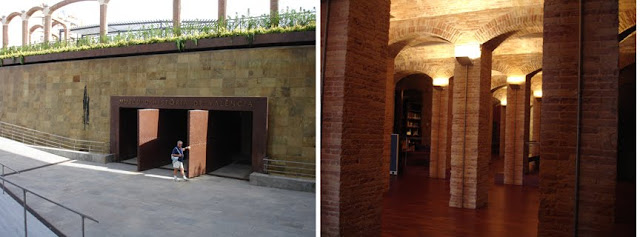
Of course everything was described in both forms of spanish, but they gave us an English guide which we read as we went along. We spent several hours there learning the fascinating, varied history of this lovely city founded by the romans, conquered by the Moors, run by the Visigoths, reconquered several times by various other forces until it finally became a region of Spain. We learned that it was the Moors who brought water technology to the city - establishing irrigation systems that allowed them to start to farm the region. We also learned about the flood of the Turia river which ran through the town. A terrible flood occurred in the late 1950's. Since then the river has been re-routed outside of the city and the dry old river bed has been turned into the largest city park anywhere in Spain.
This is turning out to be a very interesting city, indeed!
Yesterday (Tuesday) our first challenge was to locate where to buy a 3 day bus/metro pass. We have a car at our disposal here which we will use extensively outside of the city but it looked easier to navigate around the city using public transportion. This had worked well for us in Nice. Well, it took us over two hours and much walking to locate where we could buy the bus passes. We even went to the administrative offices for the bus company in the center of the old town. They didn't sell them but they did actually point us to a tobacco shop which did sell us the precious tickets. Phew!
Our first sight-seeing target was the market. Unlike in France where they set up and take down everything on market day, this is a permanent building (completed in 1928) with permanent stalls (hundreds of them!). The guidebook says it is one of the largest markets in Europe and I believe it. It is hard to capture in pictures.
Inside where tons of fresh produce, meats and fish stalls along with bakery and candy stores. It was pretty amazing but all we bought was a small purple onion for sandwichs. It cost 10 cents. I think the woman who sold it to us was amused by our purchase.
As we left the market we kept stumbling across a lot of very interesting looking buildins. Nothing was labelled! We went into one magnificent building, wandered around, took pictures and then later looked up what we had seen.
Larry has been studying Spanish for the past 5-6 months. Specifically he is learning Latin Americna Spanish, but there isn't that much difference from Castillon so we hoped he would be understood. Well, as it turns out, here in Valencia, they have maintained their own version of Spanish - called Valencian. It is difficult enough to try to communicate in a new language, but we can't even tell which language they are using! This also makes navigating a little difficult as all the streets in the old town are labelled in Valencian and sometimes also Spanish. I found this frustrating as the navigator. All in all, I have to say that I am impressed that he has been able to get us around as well as he has. I speak no Spanish beyond "gracias" and "ola".
So, now that we had the bus passes, we found lunch at a nearby square which turned out to be a beautiful plaza with lovely buildings around it including the Chapel of Our Lady of the Abandoned built in 1652.
The Chapel was incredibly ornate and has a huge statute of the Virgin Mary. The ceiling was beautifully painted in a series of religious scenes - none of which we could figure out. There was a little connecting bridge to the cathedral which reminded me of the bridge of sighs in Venice.
Having admired the chapel we headed for the front of the cathedral. It was built in the thirteenth century and was absolutely huge inside. Less ornate than the chapel next door but very impressive. It has a very tall tower (Miguelete) attached to it which you can climb up for 3 euros but it is 207 steps. My knees begged me not to do it despite the promise of wonderful views.
Since pretty much everything closes from two to four, we headed home (by bus) to go to the grocery store and rest. We successfully located a really nice grocery store, Consum, about two blocks away. Here, as in France, we needed to be careful when we shopped as we have to be able to carry what we buy. The apartment we are in has a rolling grocery sack which was very useful and we managed to secure food for a home cooked dinner (for Wednesday) as well as snacks and sodas and some paper products.
Once somewhat rested and restored, we ventured back out to try out our navigational skills and bus passes on the buses and metros - taking 3 of them to get to the Museum of History of Valencia. It was a very, very interesting well presented museum in an amazing location - a water cistern built in the nineteenth century. It was a maze of pillars and arches - difficult to capture in a photo.
Of course everything was described in both forms of spanish, but they gave us an English guide which we read as we went along. We spent several hours there learning the fascinating, varied history of this lovely city founded by the romans, conquered by the Moors, run by the Visigoths, reconquered several times by various other forces until it finally became a region of Spain. We learned that it was the Moors who brought water technology to the city - establishing irrigation systems that allowed them to start to farm the region. We also learned about the flood of the Turia river which ran through the town. A terrible flood occurred in the late 1950's. Since then the river has been re-routed outside of the city and the dry old river bed has been turned into the largest city park anywhere in Spain.
This is turning out to be a very interesting city, indeed!
Subscribe to:
Posts (Atom)


